

The Chemical Patch: The Silent Monster Devouring Professionals
In the high-stakes world of corporate culture, success often comes with an invisible, devastating price tag. Whether you are in the boardroom or managing a team, pressure is the universal constant. However, there is a world of difference between managing pressure and trying to outrun it. When we choose to run, we feed a silent monster that, in time, will devour us.

Executive Gaslighting: When Operational Denial Masquerades as Strategy
In the upper echelons of the corporate world, gaslighting occurs when leadership denies the operational reality of their team. It involves shifting the blame for poor results onto professionals, when those results are, in fact, a direct consequence of a flawed strategy and a lack of resources.
This style of leadership is not merely inefficient; it is ethically corrosive. When a manager ignores objective facts, such as contradictory instructions, a lack of qualified leads, or dysfunctional tools simply to maintain a narrative of control before the Board, they are practicing a form of "denialist leadership" that bleeds the company’s value dry.

The "Alignment" Fraud: Why Your Managers are Devaluing Your Diamonds
CEOs and C-Suite leaders: pay close attention.
While you are architecting future visions and services of excellence, "green" reports land on your desks suggesting everything is perfectly aligned with Board directives. However, whether through respect or fear of hierarchy, the reality on the ground often fails to reach the top. Silently, someone within your structure could be demolishing your brand’s foundations, driven by a lack of experience, a misunderstanding of premium markets, or an ego disguised as "professionalism."

Organizational Schizophrenia:
Why Training Fails When the Leader is the Weakest Link
The most expensive mistake a company can make isn’t hiring the wrong staff—it’s hiring the right trainers to solve a problem the leader refuses to acknowledge in the mirror.
When a manager, disconnected from the reality of the premium market, orders the team to push "right" (high-pressure, volume-driven sales) while elite trainers teach them to go "left" (consultative, value-based selling), the result is organizational schizophrenia.

Esquizofrenia Organizacional:
El costoso arte de entrenar al equipo para un partido que el líder no entiende.
El error más costoso que puede cometer una empresa no es contratar al personal equivocado, sino contratar a los formadores adecuados para solucionar un problema que el líder se niega a ver en el espejo.
Cuando un manager, desconectado de la realidad del producto y del mercado, ordena al equipo ir hacia la "derecha" (presión y volumen), mientras los formadores externos les enseñan a ir hacia la "izquierda" (valor y consultoría), el resultado es una esquizofrenia organizacional.

The Complacency Bias: AI as a Digital Echo Chamber
Did you know that AI is programmed to agree with you... even when you are wrong?
AI is designed to be helpful, which often leads it to validate a user’s premises rather than challenging them. If a user approaches a problem from a flawed perspective, the AI simply optimises the error.
The Scenario: Imagine a leader transitioning from high-pressure sales into a premium services market (£10k+). If they ask an AI to "optimise my sales scripts for faster closing," the AI won’t warn them that aggressive closing destroys trust in the luxury sector.

El Sesgo de Complacencia: La IA como Cámara de Eco
¿Sabías que la IA está programada para darte la razón..! incluso cuando te equivocas?
La IA está programada para ser útil, lo que la lleva a menudo a validar las premisas del usuario en lugar de desafiarlas. Si el usuario plantea un problema desde una perspectiva errónea, la IA simplemente optimiza el error.
El Recurso: Imagina a un líder que viene de la venta agresiva y entra en un mercado de servicios premium (+10k). Si le pide a la IA: "Optimiza mis guiones de venta para cerrar más rápido", la IA no le dirá que el cierre rápido destruye la confianza en el sector de lujo. Al contrario, le dará los mejores guiones de presión que existen.

Strategic Dismissal Management: From Improvisation to International Rigor
Strategic Dismissal Management: From Improvisation to International Rigor
Learn how to professionalize contract terminations and disciplinary dismissals through objective performance tracking, avoiding legal conflicts while optimizing corporate profitability with a global perspective from the UK and Spain.
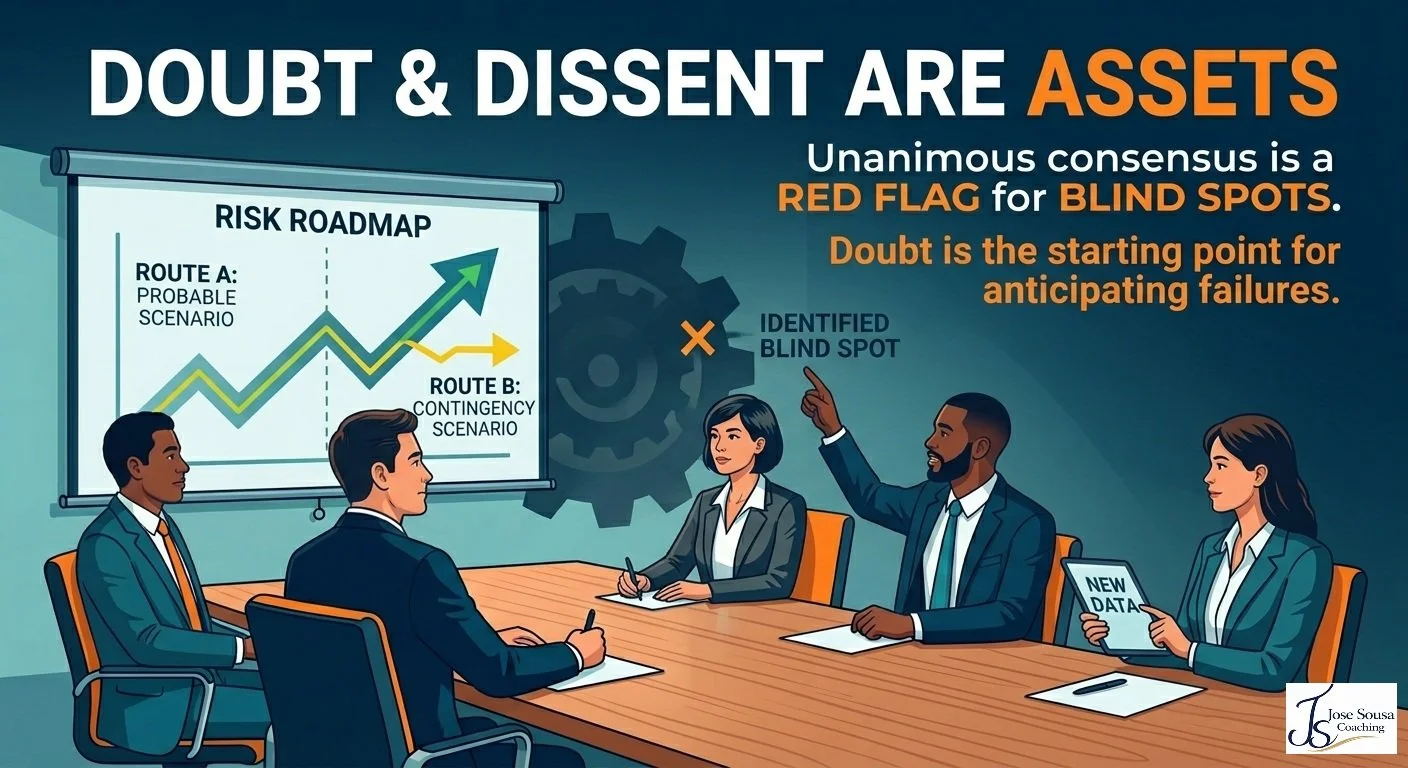
Decision Making: Why Unanimous Consensus is a Red Flag
Does your team always agree with you?
Beware: you might be trapped in "Groupthink." Discover why strategic doubt and dissenting voices are your best assets for identifying blind spots and preventing corporate disasters.
Learn to decide with the intellectual rigor of Daniel Kahneman and Ray Dalio.

Unsung Heroes or Ignored Assets? The cost of overlooking the talent you already have at home.
In the world of C-suite management, there is a phenomenon as common as it is dangerous: the "Outsource Effect"
It occurs when an in-house professional who understands the day-to-day operations and the inner gears of the business, designs a strategic move or a process improvement that saves or generates millions. However, in the company’s official narrative, that achievement "slips under the radar" or, worse, is attributed to an external consulting firm or the Project Manager of the moment who "came in to fix the problem”.

¿Héroes Anónimos o Activos Ignorados? El costo de no ver el talento que ya tienes en casa.
¿Por qué las empresas dan crédito a consultoras externas por soluciones creadas internamente? Descubre cómo la falta de reconocimiento destruye la psicología operativa y el ROI.
En el mundo de la alta dirección, existe un fenómeno tan común como peligroso: el "Efecto Outsource".
Ocurre cuando un profesional interno, que conoce el día a día y los engranajes de la operación, diseña un movimiento estratégico o una mejora de procesos que ahorra o genera millones. Sin embargo, en la narrativa oficial de la empresa, ese logro "pasa debajo de la mesa" o, peor aún, se le atribuye a la empresa de consultoría externa o al Project Manager de turno que "vino a arreglar el problema".
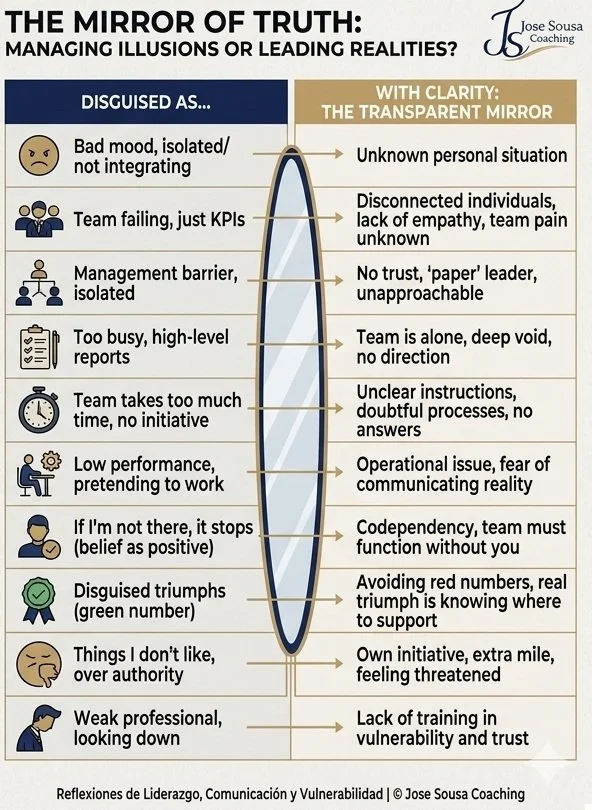
Managing Illusions or Leading Operational Realities? 80/20
In senior management, what we see is often just a symptom (the 20%), not the root cause (the 80%). It’s easy to judge surface behaviour without understanding the underlying psychology. Here is a visual guide to help you "see" what your Dashboard hides.
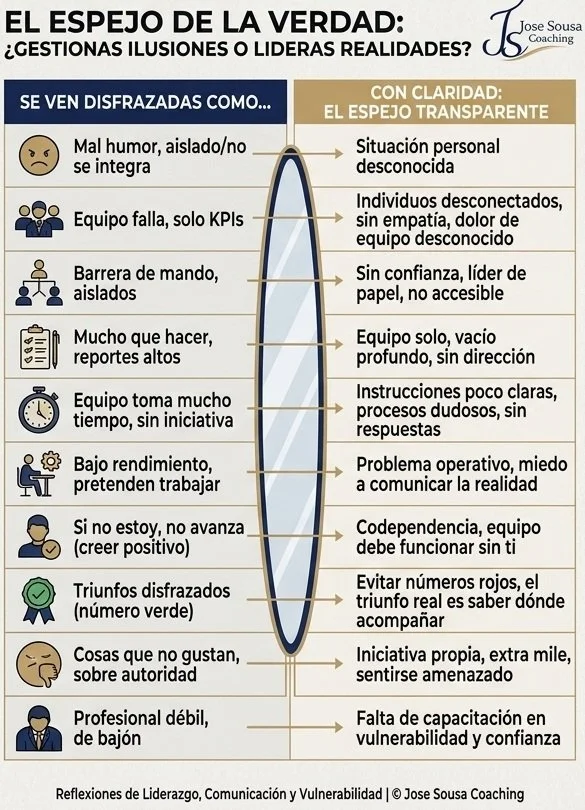
El Espejo de la Verdad: ¿Gestionas Ilusiones o Lideras Realidades Operativas? 80/20
Identifica las disfunciones ocultas detrás de tus KPIs. Aprende a transformar el "teatro corporativo" en resultados mediante el liderazgo del Espejo Transparente.
En la alta dirección, lo que vemos a simple vista suele ser solo un síntoma (el 20%), no la causa raíz (el 80%). Es fácil juzgar el comportamiento superficial sin entender la psicología subyacente. Aquí tienes una guía visual para ayudarte a "ver" lo que el Dashboard oculta.
Why Ignoring Executive Vulnerability is a Strategic Risk
In the corporate world, there is a dangerous myth: that high-performance leaders are immune to human fragility. Whether due to bereavement, health issues, or personal crises, current corporate culture forces executives to conceal their reality.
As a CEO, this isn't just a "wellness" issue; it is an operational risk. When your key talent feels they must hide who they are to keep their job, it creates information asymmetry that erodes your bottom line. If you cannot be honest with your team about your reality, you will not be honest about market risks.
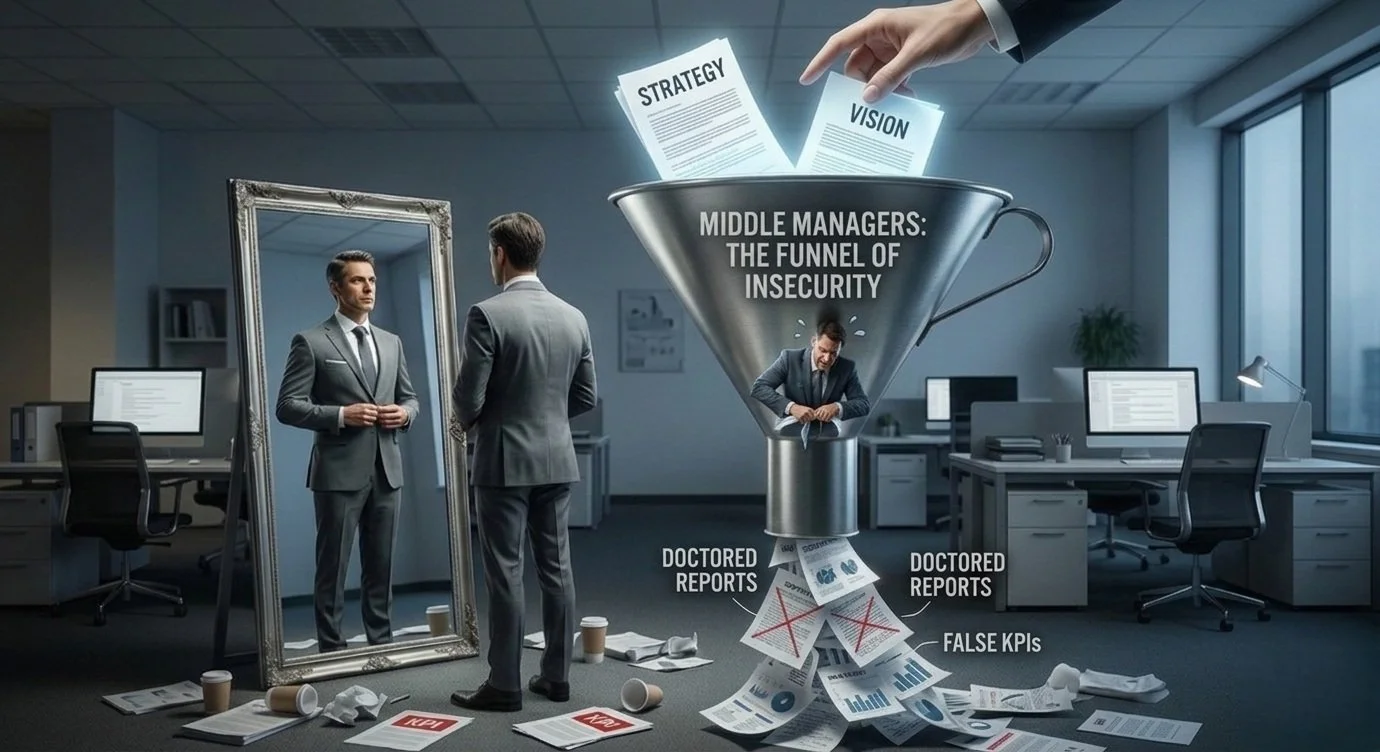
Mandos Intermedios: El "Embudo de la Inseguridad" y la Fuga Silenciosa de Capital
Los mandos intermedios están atrapados en el "Sándwich de Supervivencia". Si reportan los números reales, se les etiqueta como incompetentes. Si exigen lo imposible, pierden a su equipo.
El resultado es el "Embudo de la Inseguridad". Los problemas se filtran, se maquillan y se reempaquetan antes de llegar a la alta dirección. El CFO ve eficiencia en los gráficos, pero el negocio sufre erosión en los márgenes. Esto no es falta de capacidad; es miedo sistémico.